A1 English
Test for Beginners.
Test your beginner English skills with the Hartsford A1 English Test. This structured 30-minute online assessment evaluates grammar, vocabulary, reading, and listening.
A1 is the first CEFR level for basic language users. It is designed around familiar expressions, simple personal information, and straightforward everyday communication.
UNDERSTANDING THE LEVEL
What does
A1 actually mean?
A1 is the first level on the CEFR scale and sits within the Basic User band. At this stage, English is mainly used for familiar, concrete situations: introductions, personal information, simple requests, common objects, places, times, and everyday needs.
A1 is not “bad English”.
It is a defined starting level with a clear set of communication tasks that a learner can perform in simple conditions.
According to the Council of Europe, A1 learners can understand and use familiar everyday expressions and very basic phrases, introduce themselves and others, ask and answer simple questions about personal information, and interact simply when the other person speaks clearly and slowly.
AFTER THE TEST
The result gives you
a clearer next step.
If your performance is consistent with A1, you have a clearer picture of your current starting level. From there, you can strengthen the basics, continue learning, or work towards A2. If your result is weaker than expected, that is useful information too — it tells you where the foundation still needs work.
Moving from A1 to A2 means becoming more comfortable with frequent expressions, routine exchanges, and a wider range of familiar topics.
A1 IN REAL LIFE
What can an A1 learner actually do?
A level is easier to understand when you see the language in situations people actually encounter.
Personal Information
Give your name, nationality, address, occupation, and other simple information about yourself and people you know.
Simple Transactions
Understand and use basic English while ordering food, buying something, asking about prices, or requesting simple help.
Places & Directions
Understand simple directions and talk about familiar places such as your home, neighbourhood, workplace, or local area.
Simple Conversation
Exchange simple information when the other person speaks clearly, slowly, and is prepared to help.
THE ONLINE TEST
Four areas.
One A1 assessment.
The Hartsford online English test is completed in approximately 30 minutes and focuses on four core areas of beginner-level English.
Grammar
Basic sentence structure, common verb forms, articles, pronouns, prepositions, question forms, and other grammar patterns expected at beginner level.
Vocabulary
Familiar words and expressions connected with people, places, numbers, time, food, routines, everyday objects, and other common situations.
Reading
Short and familiar written material, including simple sentences, practical information, signs, notices, and everyday text.
Listening
Basic spoken English in familiar contexts, with attention to common words, simple phrases, short exchanges, and clearly delivered information.
The online assessment is designed to be completed within a focused 30-minute session.
HOW THE ASSESSMENT WORKS
A structured check of your
current beginner English.
The assessment is organised around four areas that give a practical view of beginner-level English: Grammar, Vocabulary, Reading, and Listening. Together, they examine both language knowledge and understanding in common English contexts.
Read the questions
Work through the assessment carefully and use your own current English rather than outside help.
Work across four areas
The questions cover Grammar, Vocabulary, Reading, and Listening within beginner-level English.
Review your result
Use the result as an indication of how your current performance compares with the A1 level and as a guide for your next step.
WHY THESE AREAS?
Four areas.
A clearer picture.
Beginner English is not only about remembering words or grammar rules. A learner also needs to recognise language in writing and understand simple spoken English. The four areas used here reflect those different parts of basic language performance.
Checks whether basic sentence structures and common forms are understood and used appropriately.
Looks at familiar words and expressions used in everyday beginner contexts.
Checks understanding of short, familiar written material and practical information.
Checks understanding of clear, simple spoken English in familiar situations.
UNDERSTANDING YOUR RESULT
What your A1 result
can tell you.
A level result is an indication of current performance, not a permanent label. A result consistent with A1 can help you identify your starting point, understand the areas that need further practice, and decide whether continuing at A1 or working towards A2 makes sense.
A1 result: a clearer indication of your current beginner level and the foundation you may want to strengthen.
Below A1: an indication that further foundation work may be useful before moving to the next level.
Working towards A2: use your result alongside continued study to decide when to progress.
WHO IS IT FOR?
The A1 test makes sense for people
at the beginning of their English journey.
Starting English
You have recently started learning English and want to understand where your current ability sits.
Checking Progress
You have studied basic English and want a clearer indication of whether your skills are reaching A1.
Preparing for A2
You want to confirm your current foundation before moving on to the next CEFR level.
Checking Your Baseline
You simply want a practical starting point before choosing how and what to study next.
VOCABULARY & PROGRESSION
What does it take to master A1?
Metrics and study expectations.
Reaching and completing the A1 level requires a solid foundation in high-frequency vocabulary and consistent exposure to simple English. Here are the practical milestones learners at the A1 stage are expected to meet before progressing.
300–500 Core Words
At the A1 English level, learners typically need to command around 300 to 500 commonly used words and phrases. This foundational vocabulary vocabulary covers essential everyday topics needed for survival communication.
- Personal basics: Family members, nationality, age, and simple introductions.
- Everyday essentials: Numbers, colours, days of the week, months, and time.
- Action verbs: High-frequency verbs like be, have, go, do, make, eat, drink, and want.
A1 Reading Materials
An A1 learner can comprehend very simple written texts containing familiar vocabulary. Rather than complex paragraphs, A1 reading is mostly functional and directly related to immediate personal environments.
- Public notices: Short signs, street directions, warning notices, and basic product labels.
- Simple correspondence: Postcards, short birthday cards, and brief everyday emails.
- Structured data: Grocery lists, train schedules, menus, and personal information forms.
Basic Speaking Limits
Speaking proficiency at this stage relies heavily on memorised phrases rather than spontaneous sentence construction. A1 speakers can confidently express basic needs ("I would like...", "Where is..."), make simple purchases, and engage in basic transactions. However, smooth communication requires the other person to speak slowly, clearly, and be willing to assist by repeating or rephrasing words.
Progressing to A2
Moving beyond A1 requires consistent, structured practice. On average, it takes approximately 60 to 80 hours of guided study to progress from a standard A1 level to the beginning of A2.
To accelerate this, learners should use language-learning apps daily, watch basic English content with subtitles, practice writing simple daily routines, and actively listen to beginner-level podcasts to train their ear to natural pronunciation.
BEFORE THE TEST
How to get a more useful result.
The goal is not to make the test look easy. The goal is to let your result reflect your actual English as closely as possible.
Choose a quiet place
Give yourself enough concentration to read each question properly and listen carefully if the assessment includes audio.
Answer without outside help
A level test is useful only when the answers represent your own current ability.
Read the whole question
At beginner level, small details matter. Word order, articles, prepositions, and basic verb forms can change the meaning of a sentence.
Treat the result as a guide
A test result is most useful when you use it to decide what to study next — rather than as a judgment about your ability.
DOCUMENTED RESULT
When the result is worth keeping.
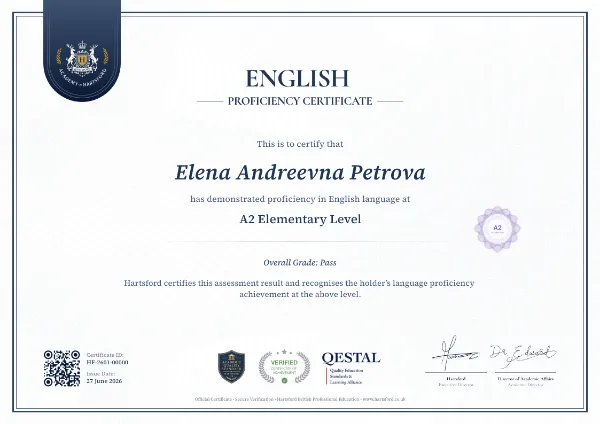
Where a Hartsford English assessment results in a certificate, the document records the candidate's name, assessed CEFR level, examination result, issue information, and certificate identification used for verification.




A1 QUESTIONS
Questions people usually ask before taking the test.
A1 is simple in structure, but it is often misunderstood. These answers keep the level practical.
What is A1 English level?
A1 is the first CEFR reference level and belongs to the Basic User group. It describes a learner who can understand and use familiar everyday expressions and very basic phrases, give simple personal information, and interact in straightforward situations when the other speaker communicates clearly.
Is A1 the lowest English level?
A1 is the lowest of the six main CEFR reference levels. Some learners may be described as Pre-A1 when their English is still below the first reference level.
What can I do in English at A1?
At A1 you can handle very basic communication: introduce yourself, give simple personal details, ask and answer straightforward questions, understand familiar everyday expressions, and communicate simply when the other person speaks clearly and slowly.
Is A1 enough for professional work?
A1 is a beginner level. It can support very simple workplace interactions in familiar situations, but it should not automatically be presented as evidence of professional or advanced English proficiency. The language required for a job depends on the role and the organisation.
What does the Hartsford A1 online test cover?
The Hartsford A1 online test covers four areas: Grammar, Vocabulary, Reading, and Listening. The assessment is completed online and is designed to take approximately 30 minutes.
How difficult is an A1 English test?
A1 is designed for beginners, so the language is based on common words, simple structures, familiar topics, and basic communication. The test can still distinguish between someone who has memorised isolated phrases and someone who can actually use basic English in context.
Can I take the A1 test if I am completely new to English?
Yes. A1 is specifically intended to describe very early-stage language ability. However, someone with almost no English may fall below A1 and may be better described as Pre-A1.
What comes after A1?
The next CEFR reference level is A2. At A2, learners can understand more frequent expressions, deal with simple routine exchanges, and communicate about a broader range of familiar matters.
Is CEFR the same as a test?
No. CEFR is a framework for describing language proficiency. Different assessment providers can design tests that are aligned to CEFR levels. The level describes the ability; the test is the method used by a provider to assess that ability.
What happens after I complete the Hartsford A1 test?
Your result gives you an indication of your current performance against the A1 level. Depending on the outcome and the Hartsford assessment process, you can use the result to understand your starting point, continue studying, or progress toward a higher level.
How many words should you know for A1 Level English?
At the A1 English level, learners typically need an active vocabulary of around 300 to 500 commonly used words. This includes high-frequency vocabulary such as basic verbs (be, have, do), numbers, days of the week, family members, everyday objects, and polite greetings. Building this foundational vocabulary is essential before moving to A2.
What can an A1 English learner read?
Reading comprehension at the A1 level focuses on very short, simple texts with familiar words. Typical A1 reading materials include street signs, warning notices, product labels, short basic emails, grocery lists, and simple schedules. Learners at this stage rely on repetitive vocabulary and struggle with complex paragraphs or abstract topics.
What are the speaking skills expected at A1?
Speaking at A1 is highly practical but limited. An A1 learner can introduce themselves, ask and answer basic questions about personal details, and make simple requests like asking for directions or ordering food. However, they usually speak slowly and need the listener to be patient, speak clearly, and assist in the conversation.
How many hours does it take to move from A1 to A2?
While individual learning speeds vary, most established language frameworks suggest it takes approximately 60 to 80 hours of focused study to progress from A1 to A2. This timeframe includes studying grammar, expanding vocabulary to around 1,000 words, and consistently practicing reading, listening, and speaking skills.
Start the A1 English Test.
Grammar. Vocabulary. Reading. Listening. Four areas designed to give you a clearer picture of your current A1-level English.