A2 English
Test for Elementary Learners.
Test your elementary English skills with the Hartsford A2 English Test. This structured 30-minute online assessment evaluates grammar, vocabulary, reading, and listening.
A2 is the second CEFR level for basic language users. It covers familiar everyday situations, routine exchanges, practical information, and simple descriptions of your background and immediate environment.

UNDERSTANDING THE LEVEL
What does
A2 actually mean?
A2 is the second level on the CEFR scale and remains within the Basic User band. At this stage, learners can deal with a broader range of familiar situations, exchange straightforward information, talk about routines and immediate needs, and describe their background and surroundings in simple language.
A2 is more than memorised survival English.
It represents a practical step beyond A1, with greater ability to manage routine communication and connect simple ideas across familiar topics.
According to the Council of Europe, A2 learners can understand frequently used expressions related to areas of immediate relevance, communicate in simple routine tasks requiring a direct exchange of information, and describe aspects of their background, immediate environment, and immediate needs.
AFTER THE TEST
The result gives you
a clearer next step.
If your performance is consistent with A2, you have a clearer picture of your ability to handle routine English in familiar situations. From there, you can consolidate your elementary skills, strengthen weaker areas, or begin working towards B1.
Moving from A2 to B1 means becoming more independent in familiar communication, understanding the main points of clear standard English, and handling a wider range of everyday situations.
A2 IN REAL LIFE
What can an A2 learner actually do?
A2 becomes easier to understand when you look at the routine situations where elementary English is genuinely useful.
Daily Routines
Talk about your daily routine, habits, work or study, free time, family life, and other familiar activities using simple connected language.
Shopping & Services
Ask about prices, sizes, opening times, services, food, tickets, and other practical details in familiar everyday transactions.
Travel & Directions
Ask for and give simple directions, understand practical travel information, and deal with predictable situations in places such as stations, hotels, and shops.
Simple Conversation
Exchange straightforward information about familiar topics, talk about plans and past activities, and respond to simple questions in routine situations.
THE ONLINE TEST
Four areas.
One A2 assessment.
The Hartsford online English test is completed in approximately 30 minutes and focuses on four core areas of elementary-level English.
Grammar
Common sentence structures, verb forms and tense contrasts, articles, pronouns, prepositions, comparatives, question forms, modal expressions, and other grammar used in routine elementary communication.
Vocabulary
Familiar vocabulary and expressions related to daily routines, family, work and study, shopping, travel, places, services, food, health, leisure, and other common situations.
Reading
Short and straightforward written texts containing familiar language, practical information, simple messages, notices, schedules, advertisements, forms, and everyday communication.
Listening
Clear everyday spoken English involving familiar topics, routine exchanges, practical information, simple instructions, and short conversations delivered at a manageable pace.
The online assessment is designed to be completed within a focused 30-minute session.
HOW THE ASSESSMENT WORKS
A structured check of your
current elementary English.
The assessment is organised around four areas that give a practical view of elementary English: Grammar, Vocabulary, Reading, and Listening. Together, they examine language knowledge and understanding in familiar English contexts.
Read the questions
Work through each question carefully and use your own current English rather than outside help.
Work across four areas
The questions cover Grammar, Vocabulary, Reading, and Listening within elementary-level English.
Review your result
Use the result as an indication of how your current performance compares with the A2 level and as a guide for your next step.
WHY THESE AREAS?
Four areas.
A clearer picture.
Elementary English is not only about recognising more words or remembering grammar rules. A learner also needs to understand practical written information and follow clear spoken English in familiar situations. These four assessment areas provide a focused view of that foundation.
Checks whether common structures and grammatical forms are understood and used appropriately in familiar communication.
Looks at familiar words and expressions needed for routine everyday situations and common topics.
Checks understanding of short, straightforward written material and predictable practical information.
Checks understanding of clear spoken English in familiar and routine situations.
UNDERSTANDING YOUR RESULT
What your A2 result
can tell you.
A level result is an indication of current performance, not a permanent label. A result consistent with A2 can help you understand how confidently you handle routine English, identify areas that need further practice, and decide whether to consolidate A2 or begin working towards B1.
A2 result: a clearer indication of your current elementary level and how well you manage familiar routine communication.
Below A2: an indication that some A1 foundations or routine language skills may still need strengthening.
Working towards B1: use your result alongside continued study to decide when you are ready for more independent English use.
WHO IS IT FOR?
The A2 test makes sense for learners
who are moving beyond beginner English.
Building Beyond A1
You have learned the basics and want to find out whether your English is now functioning at the A2 elementary level.
Checking Progress
You have been studying elementary English and want a clearer indication of how your current ability compares with A2.
Preparing for B1
You want to confirm your A2 foundation before moving towards the first CEFR Independent User level.
Confirming Your Level
You want a practical assessment of your current English before deciding what to study or which level to target next.
A2 IN PRACTICE
What does elementary English
look like in real use?
A2 is defined by what a learner can understand and communicate in familiar situations. The focus is practical: routine exchanges, everyday information, short texts, clear spoken English, and simple descriptions of people, places, activities, and plans.
Everyday Language
A2 learners need enough language to deal with familiar routines and practical situations. This includes talking about family, work or study, shopping, travel, food, free time, places, services, schedules, and everyday needs.
- Routine topics: Family, work, school, hobbies, food, travel, and daily activities.
- Practical language: Requests, questions, directions, prices, times, and simple instructions.
- Connected information: Linking short ideas to explain routines, experiences, preferences, or plans.
A2 Reading Materials
A2 reading is still straightforward, but it goes beyond isolated signs and labels. Learners can work with short practical texts and predictable everyday information when the language is familiar.
- Practical texts: Menus, notices, schedules, advertisements, forms, and directions.
- Everyday messages: Short emails, messages, invitations, reminders, and personal notes.
- Simple information: Straightforward descriptions and texts about familiar people, places, and activities.
A2 Speaking Ability
A2 speakers can manage simple routine exchanges and communicate limited but useful information about familiar topics. They can ask and answer questions, talk about routines and past activities, discuss simple plans, give directions, and describe people or places in basic connected language. Conversations may still involve pauses and reformulation, especially when the topic becomes less predictable.
Progressing to B1
Moving beyond A2 means becoming more independent with familiar English. At B1, learners are expected to understand the main points of clear standard input on familiar matters and deal with many situations that arise during travel, work, study, and everyday life.
The practical goal is not memorising a fixed number of words or following a universal number of study hours. It is developing the ability to perform the communication tasks associated with the next CEFR level consistently.
BEFORE THE TEST
How to get a more useful result.
The goal is not to make the test look easy. The goal is to let your result reflect your actual English as closely as possible.
Choose a quiet place
Give yourself enough concentration to read each question properly and listen carefully when the assessment includes audio.
Answer without outside help
An English level test is useful only when the answers represent your own current ability.
Read the whole question
At A2, details matter. Verb forms, prepositions, word order, connectors, and context can change the meaning of a sentence or short text.
Treat the result as a guide
A test result is most useful when you use it to decide what to strengthen next — rather than as a permanent judgment about your ability.
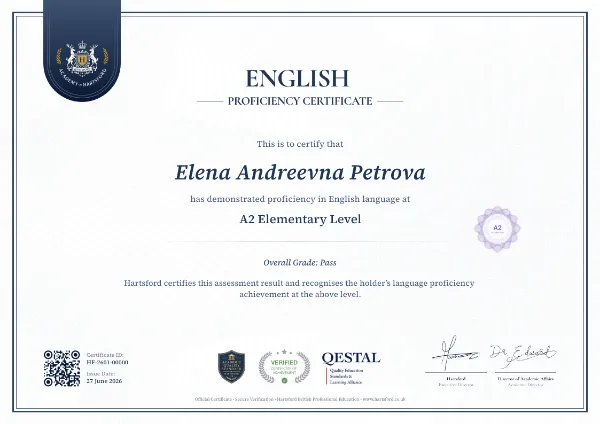
DOCUMENTED RESULT
When the result is worth keeping.
Where a Hartsford English assessment results in a certificate, the document records the candidate's name, assessed CEFR level, examination result, issue information, and certificate identification used for verification.





A2 QUESTIONS
Questions people usually ask before taking the test.
A2 is often described simply as “elementary”, but the level is more useful when its practical abilities are clear.
What is A2 English level?
A2 is the second CEFR reference level and belongs to the Basic User group. At A2, learners can understand sentences and frequently used expressions related to familiar areas such as personal and family information, shopping, local surroundings, and work. They can communicate in simple routine situations and describe aspects of their background and immediate environment.
What can I do in English at A2?
At A2, you can communicate in simple and routine situations, exchange straightforward information about familiar topics, talk about your background and daily life, describe your immediate surroundings, make requests, ask for and give directions, and discuss familiar activities and plans.
Is A2 an elementary English level?
Yes. A2 is commonly described as an elementary level within the CEFR Basic User band. It represents a step beyond A1, with greater ability to handle routine communication and a broader range of familiar situations.
Is A2 enough for professional work?
A2 can support simple workplace communication in familiar and predictable situations, especially when the language is routine. It should not automatically be presented as evidence of independent professional English proficiency. The level required for work depends on the role, industry, and communication demands.
What does the Hartsford A2 online test cover?
The Hartsford A2 online test covers four areas: Grammar, Vocabulary, Reading, and Listening. The assessment is completed online and is designed to take approximately 30 minutes.
How difficult is an A2 English test?
A2 is more demanding than A1 because learners are expected to understand and use a wider range of familiar language. The test can include routine situations, short connected information, common grammatical structures, everyday vocabulary, and simple spoken or written texts.
Can I take the A2 test if I am still at A1?
You can take an A2 assessment to check whether your current ability has progressed beyond A1. If your performance is not yet consistent with A2, the result can still show which parts of your English need further development.
What comes after A2?
The next main CEFR reference level is B1. At B1, learners move into the Independent User band and can understand the main points of clear standard English on familiar matters and deal with many situations that arise while travelling.
Is CEFR the same as a test?
No. CEFR is a framework for describing language proficiency. Test providers can design assessments that relate results to CEFR levels. The CEFR describes the level of ability; the test is the assessment method.
What happens after I complete the Hartsford A2 test?
Your result gives you an indication of your current performance against the A2 level. You can use the result to understand your present level, identify areas for further practice, and decide whether to consolidate A2 or begin working towards B1.
How much vocabulary do I need for A2 English?
The CEFR does not define A2 by a single official number of words. A2 requires enough familiar vocabulary to handle routine everyday communication, talk about immediate needs and familiar topics, and understand commonly used expressions. Vocabulary range should therefore be judged by what the learner can actually understand and communicate, not by a single word-count target.
What can an A2 English learner read?
An A2 learner can understand short, straightforward texts containing common everyday language and predictable information. Examples include menus, notices, short messages, simple emails, schedules, advertisements, forms, directions, and other practical texts connected with familiar situations.
What are the speaking skills expected at A2?
An A2 learner can take part in simple routine exchanges, ask and answer questions about familiar topics, exchange practical information, talk about habits and past activities, discuss simple plans, and describe people, places, routines, and immediate needs using basic connected language.
How long does it take to move from A2 to B1?
There is no single reliable number of hours that applies to every learner. Progress from A2 to B1 depends on prior knowledge, learning intensity, exposure to English, quality of practice, and the amount of real communication. A more useful measure is whether the learner can consistently perform the communication tasks expected at B1.
Start the A2 English Test.
Grammar. Vocabulary. Reading. Listening. Four areas designed to give you a clearer picture of your current A2-level English.