C1 English
Test for Advanced Learners.
Test your advanced English skills with the Hartsford C1 English Test. This structured 30-minute online assessment evaluates grammar, vocabulary, reading, and listening.
C1 is the first CEFR level in the Proficient User band. It reflects the ability to handle demanding English, recognise implied meaning, communicate fluently, and use language flexibly for social, academic, and professional purposes.

UNDERSTANDING THE LEVEL
What does
C1 actually mean?
C1 is the fifth level on the CEFR scale and the first level in the Proficient User band. At this stage, English can be used flexibly across demanding social, academic, and professional settings. The learner can follow extended language, recognise meaning that is not stated directly, and organise complex ideas clearly.
C1 is defined by control, not just complexity.
Advanced proficiency involves choosing language appropriately, maintaining coherence, adjusting tone and register, and communicating nuanced meaning with relatively little hesitation.
According to the Council of Europe, C1 learners can understand a wide range of demanding, longer texts and recognise implicit meaning. They can express themselves fluently and spontaneously, use English flexibly and effectively for social, academic, and professional purposes, and produce clear, well-structured, detailed communication on complex subjects.
AFTER THE TEST
The result gives you
a clearer next step.
If your performance is consistent with C1, you have evidence of advanced English ability across the areas assessed. The result can help you identify where your language is already strong and where further work may improve precision, range, or control before progressing towards C2.
Moving from C1 to C2 means refining an already advanced command of English: understanding more subtle meaning, handling complex discourse with ease, and expressing ideas with greater precision and nuance.
C1 IN REAL LIFE
What can a C1 learner actually do?
C1 becomes clearer when advanced English is viewed through the situations where precision, interpretation, flexibility, and sustained communication matter.
Professional Communication
Handle meetings, detailed discussions, presentations, correspondence, and complex workplace information while adapting language to purpose and audience.
Academic & Analytical Language
Follow demanding academic or analytical material, distinguish major points from supporting detail, and explain ideas in a structured and coherent way.
Nuance & Interpretation
Understand implied meaning, attitude, tone, qualification, and distinctions that are not always stated directly.
Sustained Expression
Develop a position, explain relationships between ideas, handle questions, and maintain an extended contribution without excessive searching for language.
THE ONLINE TEST
Four areas.
One C1 assessment.
The Hartsford online English test is completed in approximately 40 minutes and focuses on four core areas of advanced English.
Grammar
A broad and controlled use of grammatical structures, including complex relationships between clauses, time, condition, emphasis, contrast, reported information, and other forms needed to express precise meaning.
Vocabulary
A wide lexical repertoire that supports precise expression, discussion of less predictable subjects, recognition of subtle distinctions, and appropriate choices of vocabulary according to context and purpose.
Reading
Demanding and longer texts covering academic, professional, social, and general-interest subjects, with attention to main ideas, supporting arguments, implicit meaning, tone, organisation, and inference.
Listening
Extended spoken English covering demanding discussions, presentations, interviews, explanations, and other realistic contexts where meaning may depend on structure, implication, attitude, or context.
The online assessment is designed to be completed within a focused 40-minute session.
HOW THE ASSESSMENT WORKS
A focused check of your
current advanced English.
The assessment is organised around four areas that provide a practical view of advanced English: Grammar, Vocabulary, Reading, and Listening. The emphasis is on understanding language in context and recognising the level of control required for C1 performance.
Read with precision
Consider the full context of each question. At C1, the correct interpretation may depend on implication, tone, logical relationships, or subtle differences in meaning.
Move across four areas
The questions cover Grammar, Vocabulary, Reading, and Listening to examine different dimensions of advanced language knowledge and comprehension.
Interpret your result
Use the result to see whether your current performance is consistent with C1 and where additional work may improve precision, flexibility, or comprehension.
WHY THESE AREAS?
Four areas.
A deeper picture.
At C1, proficiency is not simply a matter of knowing difficult words or advanced grammar. Strong performance also depends on interpreting meaning, following complex discourse, selecting appropriate language, and maintaining coherence across more demanding contexts. These four areas give a focused view of that foundation.
Checks breadth and control of grammatical structures and the ability to use them to express complex relationships and precise meanings.
Looks at lexical range, precision, collocational awareness, and the ability to choose language that fits the subject, context, and intended meaning.
Checks the ability to follow demanding texts, identify important details, infer unstated meaning, and understand how ideas are organised and developed.
Checks understanding of extended spoken language, including main ideas, significant detail, speaker intention, attitude, and meaning conveyed through context.
UNDERSTANDING YOUR RESULT
What your C1 result
can tell you.
A level result is an indication of current performance, not a permanent label. A result consistent with C1 can confirm a strong advanced foundation while also showing where greater precision, flexibility, comprehension, or control could still be developed before moving towards C2.
C1 result: a clearer indication of your current advanced English ability and your capacity to handle demanding language across the assessed areas.
Below C1: an indication that some B2 foundations or advanced comprehension and language-control skills may still need strengthening.
Working towards C2: use your result alongside continued development to decide when you are ready to pursue greater precision, nuance, and ease.
WHO IS IT FOR?
The C1 test makes sense for learners
who use English beyond everyday communication.
Moving Beyond B2
You have a strong upper-intermediate foundation and want to find out whether your English is functioning at the advanced C1 level.
Measuring Advanced Progress
You have been using advanced English in study, work, or daily life and want a structured indication of how your current ability compares with C1.
Preparing for C2
You want to establish whether your advanced foundation is strong enough to begin targeting the highest CEFR reference level.
Confirming Your Level
You want an objective reference point for your current English before making decisions about further study, professional development, or higher-level assessment.
C1 IN PRACTICE
What does advanced English
look like in real use?
C1 is characterised by flexible, well-controlled communication. The learner can move between detailed information, abstract discussion, professional subjects, and complex texts without being restricted to simple or predictable language.
Flexible Communication
C1 users can move comfortably between explanation, discussion, persuasion, description, and analysis. They can adapt what they say to the purpose of the interaction rather than relying on one fixed conversational style.
- Multiple purposes: Explain, evaluate, argue, clarify, summarise, and negotiate meaning.
- Adaptable language: Adjust wording, tone, and level of detail according to context.
- Sustained interaction: Contribute at length without frequent breakdowns in formulation.
C1 Reading Materials
C1 readers can work with demanding longer texts in which meaning is carried not only by vocabulary but also by structure, implication, tone, and argument. Familiarity with the subject can help, but the reader is expected to process more sophisticated written language.
- Long-form texts: Articles, reports, essays, professional documents, and extended correspondence.
- Implicit meaning: Interpret suggestions, attitudes, assumptions, and conclusions that are not stated directly.
- Complex structure: Follow how an argument is introduced, developed, qualified, and concluded.
C1 Speaking Ability
C1 speakers can express themselves fluently and spontaneously without excessive searching for expressions. They can organise extended contributions, respond to unexpected questions, develop complex points, and adjust their language when a conversation shifts in direction or purpose.
Progressing to C2
Moving beyond C1 is less about learning basic additional structures and more about refining an already sophisticated command of English. C2 adds greater ease, precision, sensitivity to nuance, and control across highly demanding situations.
The practical distinction is not a fixed vocabulary number or a guaranteed study duration. It is the consistency with which a learner can understand, synthesise, and express complex meaning at the highest CEFR level.
BEFORE THE TEST
How to get a more useful result.
At an advanced level, small differences in meaning matter. The most useful result comes from answering naturally and allowing the assessment to measure your actual control of English.
Work without outside assistance
Avoid dictionaries, translation tools, AI assistance, or help from another person. The purpose is to measure your current independent performance.
Read beyond individual words
Advanced questions often depend on the relationship between ideas, tone, implication, qualification, and context rather than on one difficult word alone.
Distinguish meaning carefully
Pay attention to register, emphasis, connectors, implied meaning, and subtle differences between otherwise similar expressions.
Use the result diagnostically
A C1 result is most useful when it shows both what you already control and which aspects of precision, range, fluency, or comprehension still deserve attention.
DOCUMENTED RESULT
When the result is worth keeping.
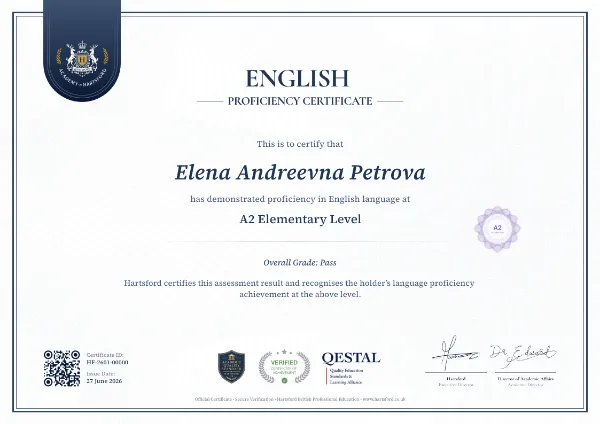
Where a Hartsford English assessment results in a certificate, the document records the candidate's name, assessed CEFR level, examination result, issue information, and certificate identification used for verification.





C1 QUESTIONS
Questions people usually ask before taking the test.
C1 is often summarised as “advanced”, but that label only becomes useful when the level is understood through the complexity, flexibility, and control it represents.
What is C1 English level?
C1 is the fifth CEFR reference level and the first level in the Proficient User band. At C1, learners can understand a wide range of demanding, longer texts and recognise implicit meaning. They can communicate fluently and spontaneously, use English flexibly for social, academic, and professional purposes, and produce clear, well-structured, detailed language on complex subjects.
What can I do in English at C1?
At C1, you can understand demanding spoken and written English, follow extended discussions and complex arguments, express yourself fluently with relatively little searching for language, adapt your style to different contexts, and produce well-organised, detailed communication on complex subjects.
Is C1 an advanced English level?
Yes. C1 is commonly described as an advanced English level. It is the first CEFR level in the Proficient User band and represents substantial independence, flexibility, range, and control in English.
Is C1 enough for professional work?
C1 can support effective and flexible English use across many professional environments, including situations involving complex information, meetings, written communication, and specialised subjects. The required level still depends on the role, industry, and consequences of communication.
What does the Hartsford C1 online test cover?
The Hartsford C1 online test covers four areas: Grammar, Vocabulary, Reading, and Listening. The assessment is completed online and is designed to take approximately 40 minutes.
How difficult is a C1 English test?
C1 requires the learner to handle demanding language with a high degree of independence. The assessment may involve complex relationships between ideas, implicit meaning, extended texts, sophisticated vocabulary, varied grammatical structures, and spoken language delivered in realistic contexts.
Can I take the C1 test if I am currently at B2?
Yes. A C1 assessment can help determine whether your current performance has developed beyond B2. If your English is not yet consistent with C1, the result can identify the areas that require greater range, accuracy, fluency, or comprehension.
What comes after C1?
The next CEFR reference level is C2. C2 represents a very high level of proficiency, including the ability to understand virtually everything heard or read, synthesise information from different sources, and express ideas spontaneously, precisely, and with fine control of meaning.
Is CEFR the same as a test?
No. CEFR is a framework for describing language proficiency. Test providers can design assessments that relate results to CEFR levels. The CEFR describes the level of ability; the test is the assessment method.
What happens after I complete the Hartsford C1 test?
Your result gives you an indication of your current performance against the C1 level. You can use it to identify strengths and limitations, determine which areas require further development, and decide whether to consolidate advanced English or work towards C2.
How much vocabulary do I need for C1 English?
The CEFR does not define C1 through a single official vocabulary word count. C1 is better understood through lexical range and control: the ability to choose appropriate language, handle less predictable subjects, distinguish between related meanings, recognise implied meaning, and communicate with precision across different contexts.
What can a C1 English learner read?
A C1 learner can understand a wide range of demanding, longer texts and recognise implicit meaning. This may include complex articles, reports, professional documents, academic material, literary or argumentative writing, and texts where meaning depends on nuance, structure, tone, or inference.
What are the speaking skills expected at C1?
A C1 learner can express ideas fluently and spontaneously with relatively little searching for expressions. They can structure extended contributions, adapt language to different situations, clarify meaning, discuss complex subjects, and communicate opinions and arguments with a high degree of flexibility.
How long does it take to move from C1 to C2?
There is no single reliable number of hours that applies to every learner. Progress from C1 to C2 depends on existing proficiency, intensity and quality of practice, exposure to demanding English, and opportunities to use the language precisely across complex contexts. The more useful measure is whether performance consistently matches C2 descriptors.
Start the C1 English Test.
Grammar. Vocabulary. Reading. Listening. Four areas designed to give you a clearer picture of your current C1-level English.