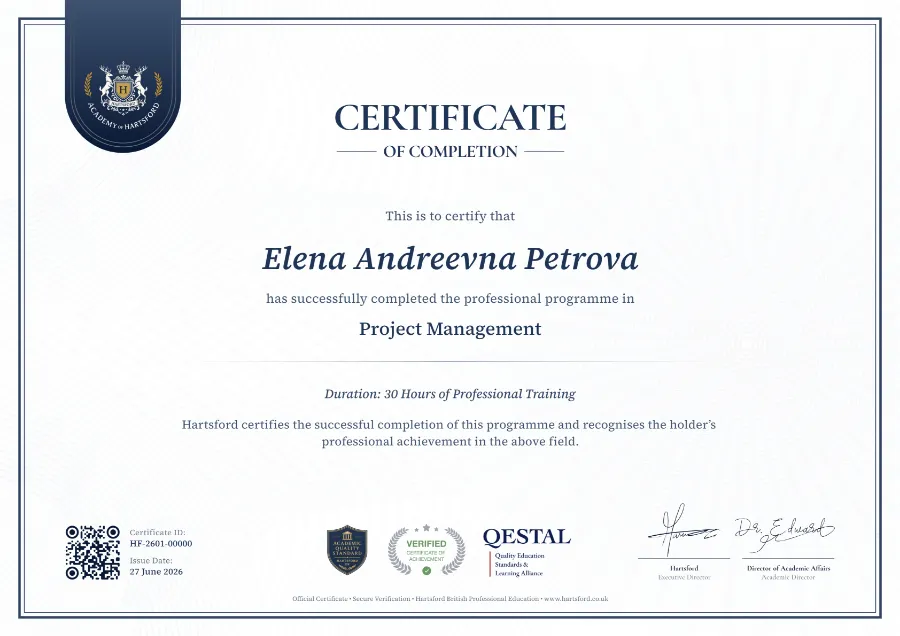
A credential is only as strong as the institution behind it. Every Hartsford certificate is designed to provide a clear, identifiable, and verifiable record of learning or assessment.
Hartsford issues two principal certificate types. They use the same core identity and verification infrastructure, while documenting different forms of educational evidence.
Awarded upon completion of a Hartsford academic or professional learning programme. It records the learner's name, programme title, professional training hours, and certificate issue date, together with the identifying information used for verification.
Issued following an English language assessment aligned to the CEFR framework. It records the candidate's assessed level from A1 to C2 and the examination outcome.
Every field exists for a reason. The certificate should communicate enough information to identify what was completed or assessed, who it belongs to, when it was issued, and how the record can be verified.
Identifies the individual to whom the certificate or assessment record belongs. The name should correspond with the learner or candidate record used for issuance.
Makes the subject of the credential explicit. A course certificate identifies the programme completed; a language certificate identifies the assessment being reported.
On course completion certificates, recorded training hours provide additional context about the amount of structured learning associated with the programme.
On English assessment certificates, the CEFR level communicates the candidate's assessed position on the A1–C2 proficiency scale. CEFR defines six principal levels and uses descriptive proficiency descriptors.
The language assessment certificate distinguishes the assessed level from the examination outcome and records the result stated on the issued document.
Records when the certificate was formally issued and creates a clear reference point for employers, institutions, or other parties reviewing the document.
Provides the document with a unique identity and a direct route to the official Hartsford verification process.
This certificate records completion of a Hartsford professional learning programme. Its role is documentary: it identifies the learner, the programme, the recorded training volume, the issue date, and the verification identity attached to the certificate.
Where a programme is delivered through a Hartsford training partner, the certificate can identify that delivery entity in the Training Partner field.
Recording training hours gives employers, learners, and organisations an additional, concrete description of the amount of structured learning associated with a completed programme.
These hours should be treated as a record of training volume. They should not automatically be represented as membership of, or formal credit from, a separate CPD accreditation body unless such status is explicitly stated.
This certificate records the candidate's assessed English level and examination result using the CEFR framework as the reference scale.
The same verification philosophy. Different educational evidence.
| FEATURE |
TYPE I
Professional Course Certificate
|
TYPE II
English Language Assessment Certificate
|
|---|---|---|
| Primary purpose | Records completion of a professional learning programme. | Records an assessed English proficiency level and result. |
| Name | Learner name | Candidate name |
| Programme / assessment | Course title | English assessment |
| Training hours | ||
| CEFR level | A1–C2 | |
| Result | Programme completion | Assessment result |
| Issue / assessment date | ||
| Training Partner | Where applicable | |
| Unique serial ID | ||
| QR verification | ||
| Online verification record |
The acceptance of a certificate for a particular purpose is determined by the organisation receiving it and by that organisation's own requirements.
The certificate is supporting evidence. Its usefulness depends on how accurately it is presented and whether the receiving organisation accepts that type of evidence for its particular purpose.
List the issuing institution, course title or language level, issue date, and verification reference where relevant. Use wording that matches the certificate exactly.
Hartsford certificate details can be presented in professional profiles and portfolios, with the relevant verification URL used when a direct supporting link is appropriate.
Where professional training or documented English proficiency is relevant to the role, the certificate can accompany an application as supporting evidence.
Certificates can sit alongside projects, references, training records, assessments, and other evidence of professional development.
Organisations may retain course certificates and assessment records alongside internal training files, employee development records, or application documentation. A clear certificate number and verification route make the document easier to reference later.
The value of a credential is increasingly tied to whether another person can understand what it represents and verify its source.
The figures below come from Accredible's 2025 State of Credentialing research and describe the broader digital-credential market. They are not Hartsford performance statistics.
of hiring professionals surveyed said they actively look for digital credentials when reviewing applications.
said they would be more likely to interview a candidate with a digital credential proving a relevant skill.
said they had hired a candidate at least partly because of a digital credential they earned.
Hartsford certificates use a unique certificate identifier and QR verification route so that a document reviewer can compare the certificate with its official online record.
Certificate verification is available through hartsford.co.uk/verify .
A Hartsford certificate is documentary evidence of the completion or assessment described on the certificate. Its meaning should be interpreted from the information stated on the document and from the context in which it is being presented.
Practical questions about certificate type, information, verification, and professional use.
A course completion certificate records completion of a professional learning programme, including the course title and recorded training hours. An English language assessment certificate records the candidate's assessed English level, based on the CEFR framework, together with the examination outcome.
Hartsford's certificate format uses a unique certificate number as part of the identification and verification process. The identifier provides a reference that can be checked through the official certificate verification service.
The QR code provides a convenient route to the official Hartsford verification process. It allows a reviewer to move from the physical or digital certificate to the relevant online verification record.
Where applicable, Training Partner identifies the trainer or training centre through which the programme was delivered. It provides additional context about delivery without changing the identity of the certificate issuer.
Yes. A course completion certificate can be included under professional development, training, continuing education, or another relevant section. The wording should accurately reflect the course completed and should match the certificate.
Yes. Where relevant, the assessed CEFR level and result may be included in a language proficiency section. The candidate should use the exact level and result stated on the issued certificate.
These are the six principal CEFR reference levels. The Council of Europe groups them into basic users (A1–A2), independent users (B1–B2), and proficient users (C1–C2). The framework uses descriptive proficiency scales rather than treating the levels as simple percentages or school grades.
No. CEFR provides a common framework for describing language proficiency, but individual employers, universities, regulators, immigration authorities, and professional bodies may specify which tests or forms of evidence they accept. The receiving organisation's requirements always take precedence.
Not automatically. Immigration authorities may require a specific approved test or evidence type. For example, the UK Skilled Worker route can require a Secure English Language Test (SELT) from an approved provider when a qualifying alternative is not available. Always check the current requirement of the specific authority and visa route.
Hartsford's certificate format does not state an expiry date, and the certificate record is intended to remain available for verification. However, the organisation receiving the certificate may impose its own rules about how recent a qualification, training record, or language result must be. Certificate validity and external acceptance are therefore separate questions.
The employer can use the QR code printed on the certificate or the unique certificate identifier to access the official Hartsford verification service. The information displayed there should be compared with the information shown on the document.
The certificate is the document presented by the learner or candidate. The verification service provides the online reference used to check the certificate's identifying information.