English Level
Test to Find Your CEFR Level.
Not sure whether your English is A1, A2, B1, B2, C1, or C2? Take the Hartsford English Level Test to assess your current performance across four core areas and identify the CEFR level that best matches your results.
A placement test starts with the question you actually have: “What is my English level?” You do not need to choose a level before you begin. The assessment gives you a structured starting point for deciding what to study, which level to target, or which Hartsford level-specific test to take next.
UNDERSTANDING CEFR
What does
CEFR actually mean?
CEFR stands for the Common European Framework of Reference for Languages. It provides a common way of describing what language users can understand, communicate, and do across different stages of proficiency.
CEFR is a framework, not a test.
Tests use their own assessment methods and can relate their results to CEFR levels. The framework provides the reference scale; the assessment provides the evidence.
The CEFR organises language proficiency into six main reference levels, from A1 to C2. The levels are grouped into Basic User, Independent User, and Proficient User, with descriptors focused on what learners can actually do with language.
WHY TAKE A PLACEMENT TEST?
Stop guessing your level.
Start with evidence.
Choosing a level from a label alone is unreliable. You may understand B1 reading material while still finding B1 listening difficult, or have studied B2 grammar without being able to use it consistently. A placement assessment gives you a structured indication of where your current performance sits before you choose the next step.
The objective is not to give you an impressive label. It is to identify the level that provides the most useful reference for what you should do next.
THE CEFR SCALE
Six reference levels.
One clear progression.
The six CEFR reference levels describe progressively more capable language use. They do not represent six fixed courses; each level covers a range of abilities, which is why a placement result is useful before choosing a specific level.
THE PLACEMENT TEST
Four areas.
A more useful level estimate.
The Hartsford placement assessment looks across four core areas of English to build a broader picture of current performance before relating it to the CEFR scale.
Grammar
Examines your control of grammatical structures across a range of difficulty, from basic sentence formation to more developed relationships between ideas, depending on your performance.
Vocabulary
Examines the range and accuracy of vocabulary you can recognise and use across familiar and increasingly demanding contexts.
Reading
Examines how well you understand written English, from simple practical material to more developed texts, according to the level of language you can process accurately.
Listening
Examines how well you understand spoken English across different levels of complexity, speed, context, and information density.
The placement assessment is designed as a focused online session so you can evaluate your current English without committing to a level beforehand.
HOW THE ASSESSMENT WORKS
You do not choose the level.
The assessment helps identify it.
A placement test has a different job from a level-specific test. You start without selecting A1, A2, B1, B2, C1, or C2 and use the assessment to establish a more appropriate starting point.
Start without a level
You do not need to decide whether you are A1, B1, B2, or C1 before beginning. Start from your actual current ability.
Work through the assessment
Questions across Grammar, Vocabulary, Reading, and Listening provide evidence of how you currently understand and use English.
Use the result
Use your CEFR indication to choose the most appropriate level-specific test, course, study path, or next learning objective.
WHY THESE AREAS?
English ability is
more than one skill.
A learner can know a grammar rule without understanding it in conversation. Someone can read comfortably while struggling to follow natural speech. Looking across several areas gives a more useful picture than relying on one narrow measure of English.
Shows how well you recognise and control grammatical patterns as language becomes more demanding.
Provides evidence of the range of language you can understand and use across different situations and levels of complexity.
Shows how successfully you can extract meaning, detail, relationships, and information from written English.
Shows how successfully you understand spoken English when information is delivered through different contexts and levels of difficulty.
UNDERSTANDING YOUR RESULT
Your result is
a starting point, not a label.
A placement result tells you how your current performance relates to the CEFR scale within the scope of the assessment. It is useful because it gives context to your next decision, whether that means strengthening your current level, taking a level-specific test, or moving forward to a higher stage.
Your level indication gives you a reference point for understanding where your current English sits on the A1–C2 scale.
A result near a level boundary may mean that some skills are stronger or weaker than others. Use the result together with your actual learning goals.
Once you know your level, you can move directly to the corresponding Hartsford A1, A2, B1, B2, C1, or C2 assessment.
WHO IS IT FOR?
The placement test makes sense when
your current level is uncertain.
You Do Not Know Your Level
You have studied English but are not sure whether your current ability is A2, B1, B2, or another CEFR level.
You Are Between Levels
You feel comfortable with one level but can also handle some material from the next one and want clearer evidence before choosing.
You Are Choosing a Course
You want a practical starting point before selecting a course, programme, study plan, or level-specific English assessment.
You Want a Baseline
You want an external reference point for your current English so that future progress can be judged against a clearer starting position.
SELF-ASSESSMENT VS TESTING
You can estimate your level.
Testing adds evidence.
Self-assessment is useful for orientation, but it is naturally subjective. A structured assessment gives you another source of evidence by asking you to demonstrate comprehension and language knowledge under the same assessment conditions.
Helps you reflect on what you think you can understand and do, especially in familiar situations.
Provides performance evidence from a defined set of questions and tasks under consistent conditions.
Use both intelligently: self-assessment for reflection and a structured test for a more independent indication of current performance.
THE HARTSFORD STANDARD
Forged for
Global Trust.
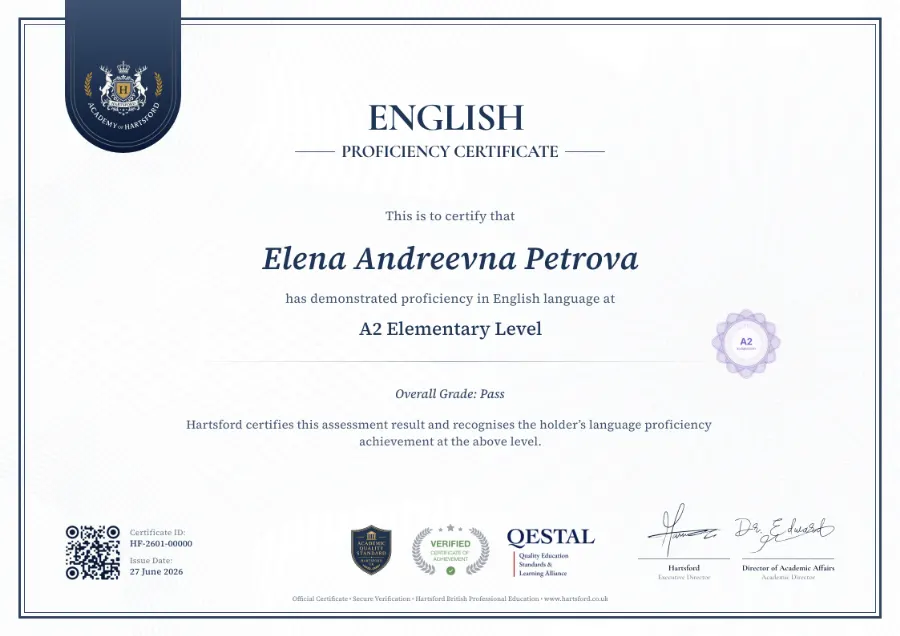
A credential is only as strong as the institution behind it. Every Hartsford certificate is designed to provide a clear, identifiable, and verifiable record of learning or assessment.
Internationally Issued
Hartsford provides professional education and certificates through a UK-based educational institution, with certificate records available for online verification.Unique & Verifiable Identity
Each certificate carries a unique serial identifier and QR verification route linking the document to its official online record.Documented Academic Information
Course certificates record the programme and training hours, while language certificates record the assessed CEFR level and examination result.BEFORE THE TEST
How to get a more useful level estimate.
A placement test works best when the result reflects what you can actually do without assistance. The aim is not to prepare for the questions; it is to measure your present ability.
Choose a quiet setting
Reduce interruptions so that your result reflects your English rather than avoidable distractions.
Do not use outside help
Avoid dictionaries, translators, AI tools, or another person's assistance if you want the result to represent your independent ability.
Answer naturally
Do not deliberately choose easier or harder answers to reach a preferred level. The value of the test comes from an honest result.
Use the result as a decision tool
Let the result guide your next choice rather than treating one test session as a permanent description of your English.
AFTER THE PLACEMENT TEST
Now you know where to start.
The purpose of finding your level is not to stop at the result. It is to make the next decision more intelligently. Once you have a CEFR indication, you can move to the relevant level-specific assessment or use the result to structure your next stage of learning.
Explore the six CEFR levelsA1–A2: build and consolidate the foundations of everyday English.
B1–B2: develop increasingly independent communication and broader language use.
C1–C2: refine advanced comprehension, flexibility, precision, and control.






PLACEMENT QUESTIONS
Questions people usually ask before testing their level.
Your English level is not something you should have to guess from a course name, a few familiar phrases, or how long you have been studying.
What is a CEFR English level?
A CEFR English level describes language proficiency using the Common European Framework of Reference for Languages. The main reference levels are A1, A2, B1, B2, C1, and C2, progressing from basic to proficient language use.
What is an English placement test?
An English placement test is an assessment used to estimate a learner's current level so they can be placed at an appropriate stage of study or understand where their English currently sits. It is different from the CEFR itself: CEFR provides the proficiency framework, while the test provides the assessment.
How can I find out my English level?
A structured English level test provides an external indication of your current performance. Self-assessment can also be useful, especially when comparing your abilities with CEFR descriptors, but it is naturally more subjective.
What English levels are there?
The CEFR has six main reference levels: A1, A2, B1, B2, C1, and C2. A1 and A2 form the Basic User range, B1 and B2 form the Independent User range, and C1 and C2 form the Proficient User range.
What is the difference between A1 and A2?
A1 describes very basic language ability for immediate and familiar situations. A2 represents a broader ability to understand frequently used language and communicate in simple routine situations involving familiar topics.
What is the difference between B1 and B2?
B1 is the first Independent User level and focuses on understanding the main points of clear language and communicating independently in many familiar situations. B2 represents greater range and fluency, including the ability to understand more complex language, develop ideas, and discuss different viewpoints.
What is the difference between C1 and C2?
C1 describes advanced, flexible language use in demanding social, academic, and professional contexts. C2 is the highest CEFR reference level and involves very high comprehension, synthesis, fluency, precision, and sensitivity to finer distinctions of meaning.
Does the CEFR measure English only?
No. CEFR is a general framework for describing language proficiency and is designed to apply across languages. English tests can use CEFR levels to describe the proficiency represented by their results.
Does CEFR equal a test score?
No. CEFR is a proficiency framework, not a single universal test or scoring system. Individual providers use their own assessments and scoring methods and may relate their results to CEFR levels.
What does the Hartsford English Level Test cover?
The Hartsford English Level Test assesses four areas: Grammar, Vocabulary, Reading, and Listening. The structured online assessment is designed to provide an indication of your current position within the CEFR A1-C2 range.
How long does the Hartsford English placement test take?
The Hartsford online English placement assessment is designed to take approximately 45 minutes.
Can a placement test tell me my exact English level?
A placement test can provide an indication of your current level based on the skills and questions it measures. A short assessment cannot capture every aspect of language ability in every situation, so the result should be treated as a structured indication rather than a permanent definition of the learner.
What if my English level is different in different skills?
That is normal. Language abilities can develop unevenly, so a learner may be stronger in reading than listening, for example. The result should therefore be understood in the context of the skills the assessment measures.
Should I take a placement test before choosing an English course?
It can be useful. A placement result gives you an evidence-based starting point and can help you avoid choosing material that is substantially below or above your current ability.
Can I take the placement test if I do not know my English level?
Yes. That is one of the main reasons to take a placement test. You do not need to know whether you are A1, A2, B1, B2, C1, or C2 before you begin.
What happens after I complete the English Level Test?
Your result provides an indication of the CEFR level that best reflects your current performance within the scope of the assessment. You can then use it to choose an appropriate level-specific test, course, study plan, or next learning objective.
Is a placement test the same as an English proficiency certificate?
Not necessarily. A placement test is primarily designed to determine or estimate a learner's current level. A proficiency certificate is a separate credential whose purpose, acceptance, assessment conditions, and verification depend on the provider and the organisation requesting it.
Find your English level.
Not sure where you belong on the CEFR scale? Start without choosing a level and use the result to identify the most appropriate next step for your English.